Understanding College: Credits, Semesters, & Quarters
How Do College Credits Work?
What Are Credits?
Credits measure how much work a course requires.
The typical formula:
- 1 credit = 1 hour in class per week
- So a typical 3-credit course = 3 hours in class per week
Typical courses:
- 1 credit: Labs, seminars
- 3 credits: Most standard classes
- 4-5 credits: Language, science with lab
Credits needed to graduate:
- Associate: ~60 credits
- Bachelor's: ~125 - 135 credits , so that means around 43 classes, or 5 - 6 each semester
- Master's: ~30-60 credits
Time Commitment
Most colleges will tell you that, depending on the major, for every one hour spent in class per week you will need to spend 2 - 3 hours doing homework or studying.
Example: 15 credits per semester (5 classes)
- 15 hours in class
- 30-45 hours homework/study
- = 45-60 hours per week (like a full-time job!)
Pro tip: Balance easy and hard courses so you don't overload yourself.
Semesters vs. Quarters
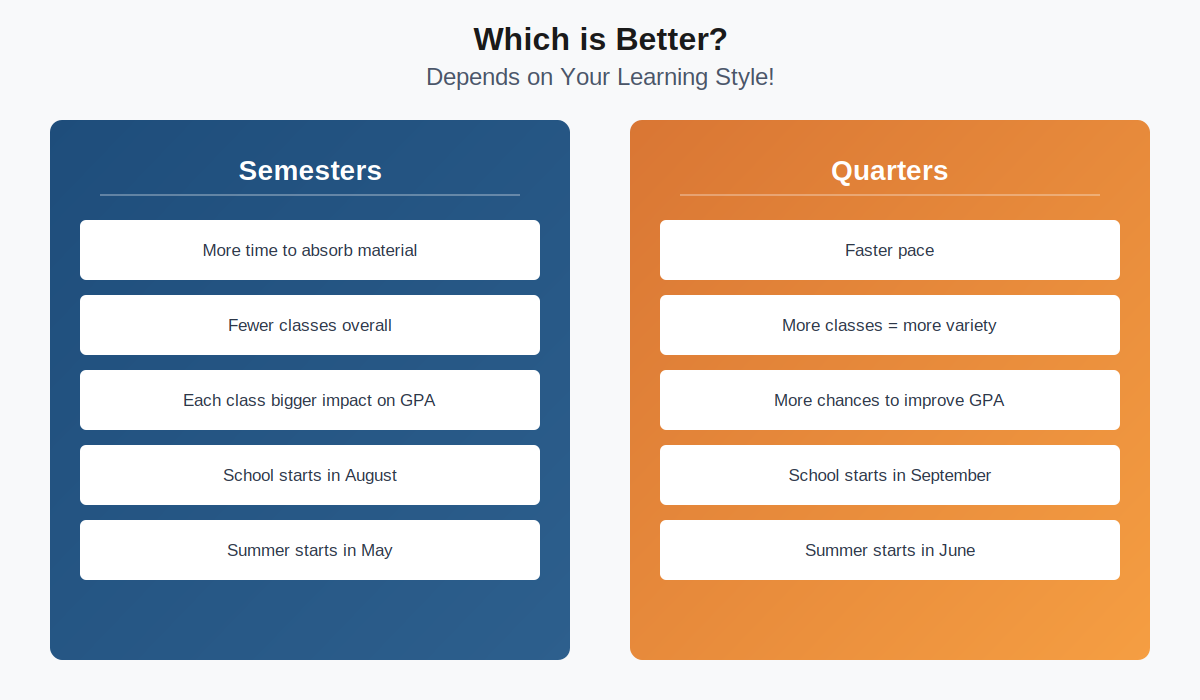
Many universities and colleges (90%+) are on a
semester schedule. Some use a
quarter system. There are also a handful of other schedules used, like ones that do intensive classes on 1-2 subjects only for 3.5 weeks and then move onto another one.
Semester System
- 2 terms per year (Fall, Spring) + optional summer
- 15 weeks each
- Take 4-6 classes per term (12-18 credits)
- 8-10 classes per year
- Schedule: Aug-Dec, Jan-May
Quarter System
- 3-4 terms per year (Fall, Winter, Spring, + optional summer)
- 10 weeks each
- Take 3-4 classes per term (9-12 credits)
- 12 classes per year (more variety!)
- Schedule: Sept-Dec, Jan-March, April-June
Schools using quarters: Stanford, most UCs, Northwestern, Drexel, Rose-Hulman, and more